
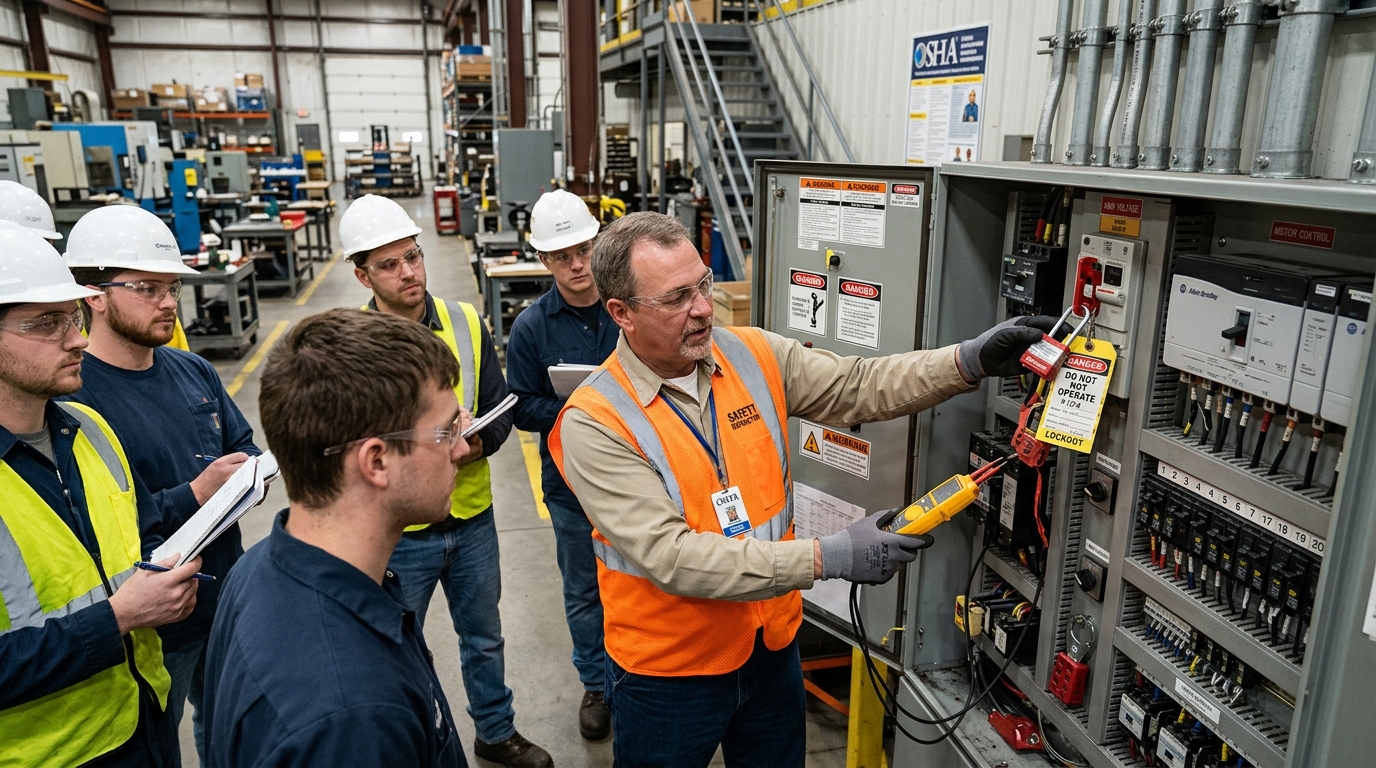
Electrical Safety
Technical training on industrial electrical hazards, earthing principles, shock rescue precautions, and safe working practices near live equipment.
Who it is for
Electricians, maintenance technicians, electrical supervisors, and facility plant engineers.
What you will learn
- Understand the physiological effects of alternating current (AC) on the human body
- Recognise electrical hazards: overloading, inadequate earthing, damaged insulation, and wet environments
- Safely de-energise, verify absence of voltage, and ground electrical systems before maintenance
- Execute non-conductive electrical shock rescue without becoming a secondary victim
Objectives are proposed syllabus content, shared for your review and adjusted to your facility.
Topics covered
- 1Ohm's law application, touch potential, and step potential concepts
- 2Earthing and bonding systems, testing earth pit resistance, and RCD/ELCB breakers
- 3Use of insulated hand tools, rubber mats, and calibrated voltage testers (multimeters/probes)
- 4Shock casualty release technique using insulated rescue hooks
Practical activities
- Voltage verification protocol demonstration using three-point testing method
- Inspection of insulated tools, gloves, and rated test meters
- Simulation of non-contact electrical rescue technique
Delivery and site needs
Delivery arrangements
Venue and delivery arrangements are confirmed during enquiry.
Site space and clearance
Access to de-energised switchboards or training test bench where safe.
Frequently asked questions
Does this replace formal industrial electrician licensing?
Related programmes
Lockout/Tagout Energy Control
Standardised training on isolating hazardous energy sources (electrical, mechanical, pneumatic, hydraulic, thermal) to ensure zero energy state before servicing.
Domestic Electrical Safety
Everyday electrical safety for homes, commercial offices, and educational campuses covering wiring checks, appliance safety, and shock prevention.
Arc Flash Protection
Specialised electrical safety training on arc flash physics, incident energy calculation concepts, flash boundaries, and arc-rated PPE selection.